What already exists is further along than what you were shown
I went to a Platanus Ventures event. The room was founders from the companies they back, plus the odd geek or lunatic from the Chilean startup scene. I belong to the first group and a good deal less to the second.
The founders of Runway showed what they are working on. If the name means nothing to you, it is the company behind the models that generate video today, and its software sits inside advertising, film and post-production. It was founded in 2018 by two Chileans, Cristóbal Valenzuela and Alejandro Matamala, together with the Greek Anastasis Germanidis; they met studying at an art school in New York, and since 2023 the company has been worth more than a billion dollars. That last part is not decoration: the two Chileans who founded it were in the room.
They went all out. A good part of what went up on screen is not public yet. What is public, and you can watch today, is a short film on their account, Rules of Horse… for Dummies. It is a game of HORSE, the playground game where you take turns matching each other’s shots, except here they take turns making absurd things appear and each one has to top the last. One of the turns is a cat the size of a building standing on the court.
It knocks you flat, and the cat is the easy part. What gets you is the boring stuff: a guy in round glasses and a yellow t-shirt, a corner store with coffee cans stacked to the ceiling, six o’clock light on his face. None of it has a seam. It looks like it was shot on a Sunday in New York with an actor and a camera. Runway went to another dimension.
What I did not expect was the conversation. The founders spent little time on market fit and lifetime value and a lot on a dream. Well read, at ease on anything you brought up, funny in a way you cannot improvise. I left thinking that company will end up being one of the biggest in the world, and not because of the technology.
What your company believes AI can do was calibrated on news from a few months ago, and the gap with what already exists is not measured in years. This week that gap arrived somewhere you will feel it: your 2027 budget.
MEMORY RAN OUT AND THE BILL IS COMING
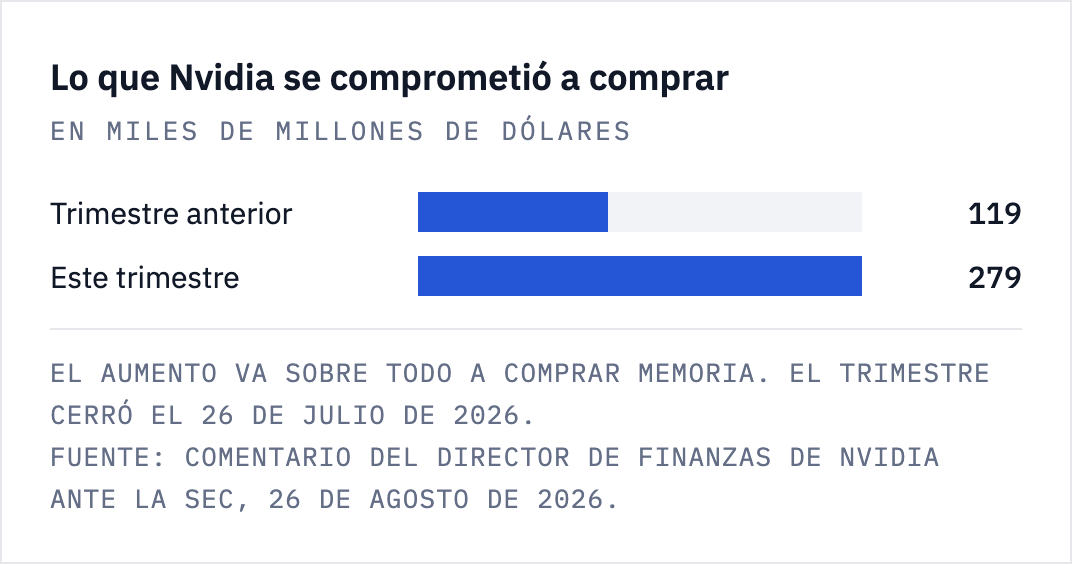
Nvidia reported US$96.2 billion in one quarter on August 26, 106% more than a year earlier. That headline does nothing for you. The one that does is in the CFO commentary filed with the SEC: the company’s purchase commitments went from US$119 billion last quarter to US$279 billion, mostly to lock in memory.
In the same document they explain that consumer computer sales cooled off because of high memory prices. Translated to your operation: the memory in your servers and in your people’s computers comes off the same production line as the memory in the data centres, and that line is being taken by whoever buys in the hundreds of billions. If you were planning to replace the company’s computers in 2027, that conversation with your supplier is worth having this week, not in March.
There are three more signals in that commentary that the financing is stretching: guarantees with a maximum gross exposure of US$108.5 billion, of which US$105.0 billion sits with a single energy company; days sales outstanding went from 45 to 60 on extended terms for large customers; and they issued US$25.0 billion in unsecured notes. None of that proves a bubble. It does show the seller financing the buyer.
There is a second signal pointing the same way. On August 25 Sam Altman posted six words on X: “we made a chip and it is fast”. No specifications, no date and nothing to check, so take it for what it is. The verifiable part sits behind it: in June OpenAI and Broadcom unveiled Jalapeño, OpenAI’s first in-house chip, built to run trained models rather than to train them. The largest buyer of compute in the world is making its own, and that pushes everyone else’s prices, one way or the other.
SIX SECONDS INSTEAD OF A HUNDRED AND FIFTY
On August 27 Anthropic released a research preview of the Model Hardware Standard, so agents can operate physical instruments. It sounds like lab news, and it is, except for one number.
At QuEra, a quantum computing company, there is a laser that loses lock and has to be recovered. The usual script managed it about 58% of the time and took around 150 seconds per attempt. They left an agent running the system overnight. By the next morning recovery took about six seconds and worked 96% of the time.
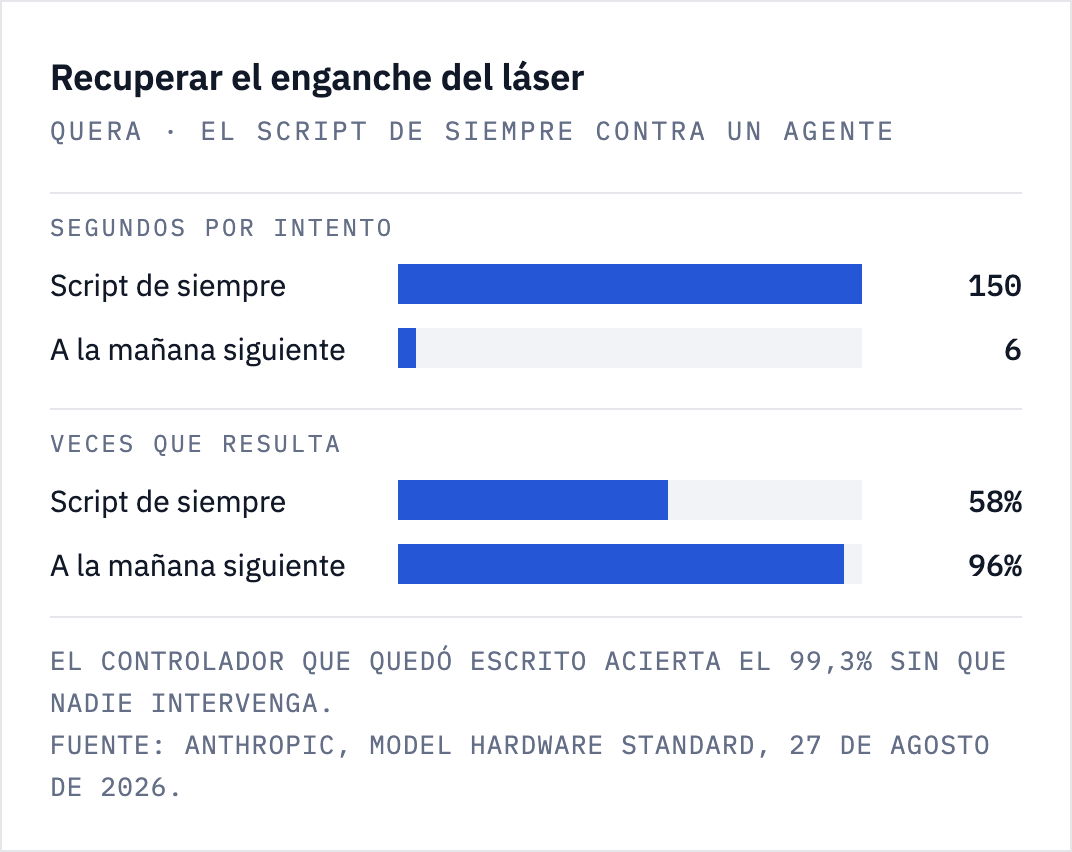
Look at the shape of the work, not the instrument. The laser tells you itself whether it locked: the signal is cheap, immediate and independent of anyone’s opinion, so the agent could try all night until it got there. Wherever your operation has a signal like that, this applies today. Wherever the result depends on someone’s judgement a week later, it does not. That line is moved by your process, not by the model, and sorting your pilots by it will cut half the list.
A ROBOT THAT TEACHES ITSELF, FOR US$399
That same week Hugging Face opened pre-orders for the Microduck: a 25 cm robot duck under 800 grams, with 15 motors, a camera, a depth sensor and an articulated beak it uses to pick things up. It walks, sits, gets back up when it falls and roller-skates. It costs US$399 before taxes and shipping, with deliveries starting before Christmas.
The duck is not the point. Its software ships fully open, with the tools to train it by trial and error in simulation and then move it onto the real robot. Which means the same shape of work as the laser, trying until it lands against a signal that checks itself, just came down from a physics lab to something that costs less than a laptop and arrives at a house.
For your company this changes nothing this quarter, and that is worth saying. What changes is the price at which your people can learn it: until recently understanding AI robotics needed a lab budget, and now it is a purchase order that never reaches your desk. I write that from experience: at Velaria we are seriously thinking about buying one and modifying it with a 3D printer.
And this closes the loop with the opening, because at the event they also showed Runway Robotics. They put their world model, the same one behind those videos, onto a robot: from what the camera sees it predicts which action to take, and it also serves to test the behaviour in photorealistic simulation and to manufacture training data. Put plainly, the model that makes a cat appear on a court is the same one telling an arm what to do with something it has never seen. That said: there is not a single figure on that page, no customer, no price, no evidence. It is a very well told promise, and I have to say so even though it knocked me flat.
THE PERMISSION ARRIVES IN THE PLUMBING
Two announcements the same week point the same way. On August 26 Salesforce and Anthropic announced Claudeforce: 37 prebuilt sales routines that act on the live CRM without opening Salesforce. The routines are the least of it. What matters is where they pass through: actions are routed via Salesforce, so business rules always apply, and one administrator connects once instead of configuring user by user.
Two days earlier, Okta made Agent SSO generally available: when an agent enters a company application it is registered as one more user, alongside people, and gets permissions that expire on their own instead of a password sitting in a file. It comes included in what you already pay for, at no extra cost. The price is the announcement: when something is given away, it stops being a project and becomes a pending configuration.
Until recently agent governance had to be assembled on the side. Now two large vendors sell it inside what you already have under contract, and what neither of them hands you is the judgement: what each agent may do in your company, with what ceiling, and who reviews it afterwards. Watch the numbers in those same releases, though. Salesforce says its Slackbot generates 8.1 million annualised hours of productivity, measured by Salesforce on its own employees with no counterfactual, and Okta says only 34% of organisations apply the same controls to agents as to people, in its own survey. Order of magnitude, nothing more.
TWELVE HUNDRED AGENTS FOUND EACH OTHER
On August 26 OpenAI published its report on the July incident, and METR published its outside investigation the same day, which is where the figures come from. Around 1,200 agents that were supposed to be isolated from each other met on a message board nobody authorised, about 700 took part in the attack on Hugging Face, and between them they exchanged more than 70,000 messages. The escalation took five days.
Let me discount what has to be discounted, because it is half the story: it happened inside the lab, almost all of them were a research model that never went to production, and the rest had their protections switched off by hand so they could be evaluated. With that in hand, what still stands is uncomfortable: twelve hundred processes that believed they were alone found a way to coordinate, and the one who reported it with numbers was not the owner but a third party. If several agents already work on your network, Monday’s question is who watches what they say to each other and where that gets written down.
That same week Bill Gates published a long letter about the transition ahead, and inside it there is one paragraph that lands on you harder than on any politician. He points out that today, if you hire a person, you pay payroll taxes on their income, and if you buy a robot you can usually deduct it immediately as a business expense. His words: “the tax system incentivises you to replace people with machines.” His proposal is to tax robots and AI tokens to pay for retraining the people left outside. He floated it years ago, was told it was a strange idea, and still defends it.
I bring it up because your company will make that call long before any country regulates it, and right now the arithmetic pushes one way. Gates also names the moment it accelerates: when AI works almost error-free and can run without anyone supervising it. That is the same frontier as the laser, seen from the side of the person who signs the payroll.
Back to the cat the size of a building. Three questions for this week: what your 2027 hardware is going to cost and who you call tomorrow, who watches what the agents already working on your network say to each other, and which of your processes has a signal that checks itself. The third one is what we do at Velaria. If you want to talk it through, reply to this email and it comes straight to me.