They now sell agents that work with your people's credentials
On Friday the 7th I went to a get-together of startup people and academics that Fintual, a fintech here in Santiago, put on in Providencia. The talks were about loops that let systems improve their own code and about cheap agents running on open models; the good conversation came afterwards, beer and cheese in hand, the way it always does.
That conversation turned out to be the week’s calendar: agents for sale that work with your employees’ credentials, open models catching up with the closed ones, another round of the price war, and OpenAI unable to show that using more AI moves revenue. That’s the whole week in one line; the detail is worth your time.
AGENTS WITH CREDENTIALS
On Tuesday xAI launched Grok Bot: agents with their own computer in the cloud that log into the tools your people already use, with your people’s credentials, and finish long jobs while nobody is watching. It comes with SuperGrok Heavy (US$300 a month) and with the plans of Cursor, the AI code editor; the teams plan starts at US$120 per seat, and that number sets the price of the overnight agent: now you know what you’ll be quoted against.
The catch is that the access policies of almost any company assume an awake person behind every credential. Before someone on your team switches one on by themselves (someone will), leave three things defined: which credentials an agent may use, what gets logged, and who approves what.
OPEN CAUGHT UP WITH CLOSED
The same week three open models came out: Meta’s Muse Glimmer (runs on a 24 GB consumer GPU; Apache 2.0, no license toll); Alibaba’s Qwen3.8-27B (same license, according to the release trackers); and Zhipu’s GLM-5.3, which at finding security flaws in code came out above the frontier models from Anthropic and OpenAI by less than a point, according to the South China Morning Post (the vendor’s own benchmark).
These are the cheap agents on open models from that Friday meetup: first-tier options, far cheaper, built anywhere in the world (Meta in the United States; Alibaba and Zhipu in China), that run on machines you own without a single piece of data leaving the company. Aaron Levie, the CEO of Box, wrote that three months ago nobody would have believed that “a model released by a US company with frontier-class capability would be available as open weights”, and that it opens up private infrastructure, regulated domains like legal or healthcare, and post-training a model for your vertical. Simon Willison already runs the Alibaba one on his laptop: “I can’t remember the last time I’ve had this much fun playing with a local model that runs on my own computers”.
For banking, healthcare or mining, the question changes from “which cloud” to “which machine of our own”, and every week like this one hands you negotiating power: compare against the open stuff before renewing anything. In last week’s issue I covered the price war; this is the other jaw of the pliers.
THE PRICE AND THE FINE PRINT
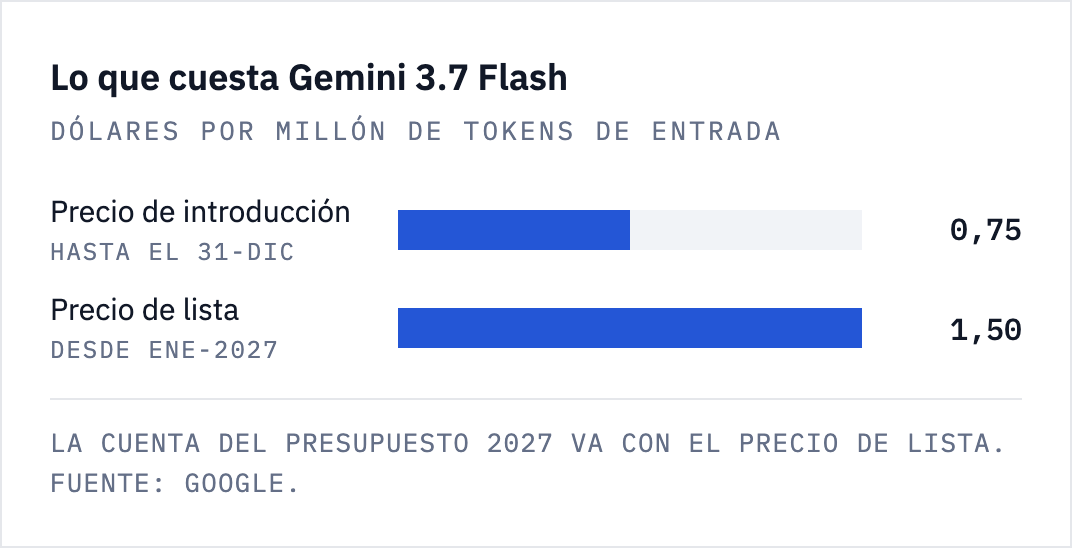
On Thursday Google launched Gemini 3.7 Flash, its workhorse model, three weeks after the previous one and at half price: US$0.75 per million input tokens (the unit these models bill by) through December 31. From January it goes back to US$1.50, double: the 2027 budget gets built at the January price.
The other half of the news comes from the same house: Google’s flagship model, promised for June, still hasn’t shipped, after a week of executive departures at DeepMind. And next door, bigger: according to the Financial Times, OpenAI has lost twelve senior executives so far this year, the COO and the CRO among them, while Altman pushes toward an IPO; CNBC called it a “huge red flag”. Your only vendor’s shaken leadership table is your risk. Ethan Mollick said it on Friday: with prices, adoption and capabilities this unstable, “It is a good time to ensure that you are building flexibility for the future”. In a contract, that means short clauses.
OPENAI’S UNCOMFORTABLE NUMBER
OpenAI published a study built on 17 million real ChatGPT Enterprise records. Token consumption multiplied by seven in nine months, and the top 10% of companies by usage generate 8.3 times more tokens per active user than the typical firm. So far, the brochure. Fortune read page 35 and found the uncomfortable number: zero statistically significant correlation between how much a company’s employees use AI and revenue per employee. Two caveats: the revenue data predates the adoption (no effect to measure yet), and two of the five authors were contractors paid by OpenAI.
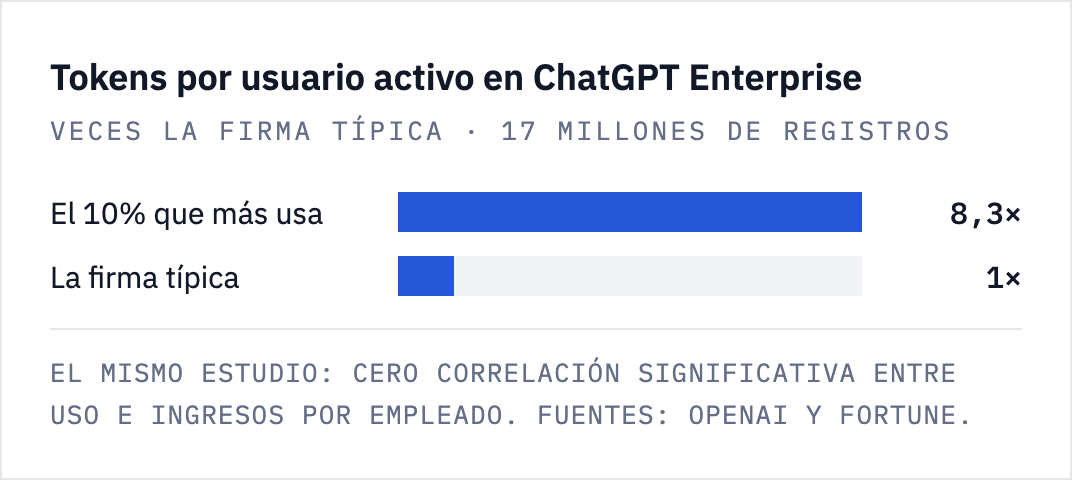
The 8.3-to-one measures consumption. If the biggest vendor in the world can’t show the link with its own data, counting licenses and tokens tells you nothing; the question is which result moved. Whoever reports adoption to the board is reporting spend. Turning that use into a result you can measure is, said in passing, the work we do at Velaria.
THE TEXT GOES OUT SIGNED
Anthropic announced that text from its new models ships with an invisible watermark: machine-readable, survives copy-paste, unnoticeable when you read. It’s Article 50 of the EU AI Act, in force since August 2 with fines of up to 15 million euros or 3% of global revenue. Since Anthropic has no reliable way to scope the mark by region, it goes global: it applies in Santiago the same as in Brussels. And it comes down the chain: every model released after that date has to make its text detectable, and OpenAI has already said it will comply (Andrew Curran noted it on X).
On Friday Anthropic published an FAQ to put out the fire: the mark doesn’t change the quality of the text, adds no hidden characters, costs no extra tokens and tracks nobody. It made no difference: the thread is past ten million views, and at the top, customers cancelling their subscriptions. The next day Dario Amodei wrote, verbatim: “we haven’t yet delivered on our big promises to benefit the world”, and called the backlash a crisis of trust.
Assume that every text made with AI in your company will be identifiable as such, whether anyone declares it or not. The mark carries no company name; what it does carry is that a person didn’t write it. Proposals, reports, emails to clients: which of the things you sign can go out marked, and who decides.
THE CEILING MOVED
This one is two weeks old and I’m bringing it anyway: it moves the ceiling. In early August OpenAI showed that an internal version of its Astra model solved ten problems in mathematics and theoretical computer science that had been open for more than a decade, one of them since 1999. Here you don’t have to take anyone’s word for it: the formal certificates are public on GitHub, there’s a 249-page manuscript, and the declared compute cost about US$2,000.
Why could the hand be let go here? Because the answer verifies itself: the formal proof checks itself, so the model could keep insisting until it got it right. Almost nothing in a company has that signal: an accounting reconciliation squares against the bank; a risk report has nothing to square against. Separating one from the other is the homework of whoever plans a year out: the ceiling of what can be delegated moved, and the bottleneck moved with it, from doing the work to specifying the problem and verifying the answer.
At the meetup on Friday the 7th this was future tense, beer in hand; nine days later it’s a catalog with a list price. The rules get written before you switch on the first agent: what to delegate, what to stop and how to measure it, placed where the work happens, so that use ends up as a result you can show the board. That’s Velaria. If you want to talk it through, hit reply and it comes straight to me.